


A prospect downloads your guide, attends a webinar, or submits an enquiry. Your sales team follows up, only to discover that the project is still taking shape. There is no approved budget, the requirements are unclear, or the person researching needs support from colleagues before taking the conversation further.
They have shown interest, but they may still need to justify the project, compare suppliers, or get approval from the people who control the budget.
B2B lead nurturing helps potential customers work through those questions. It gives them relevant information as they explore their options, while helping your team recognize when a personal conversation would be useful. The aim is to develop the relationship beyond the first interaction, rather than treat every new contact as an immediate sales opportunity.
That takes more than a scheduled email sequence. Your team needs to understand what the prospect is trying to achieve, what is holding them back, and what would help them take the next step.
What B2B Lead Nurturing Really Means
B2B lead nurturing is the process of supporting potential customers as they progress towards a buying decision. Email, useful content, advertising, and personal follow up all have a role, but they should reflect what the prospect needs rather than operate as disconnected campaigns.
Consider two people who engage with your business. One downloads a CRM migration checklist. The other requests an implementation estimate.
The first may still be deciding whether a migration is necessary. The second has asked for help assessing a project. Sending both contacts the same introductory sequence ignores an important difference in intent.
There is another complication with B2B purchases: the person researching a solution is rarely the only person involved in the decision. Finance may question the investment, IT may assess integration risks, and the operational team may worry about disruption. Your contact could be convinced while their colleagues still have unanswered questions.
Gartner describes B2B buying as a nonlinear process involving tasks such as identifying problems, defining requirements, validating choices, and building consensus. Buyers may revisit these tasks rather than move through them in a fixed order.
A good nurturing program gives prospects information they can use and share internally. Even when they are not ready to speak to sales, they should have something useful to take away from each interaction.
Mapping Nurturing to the Buying Journey
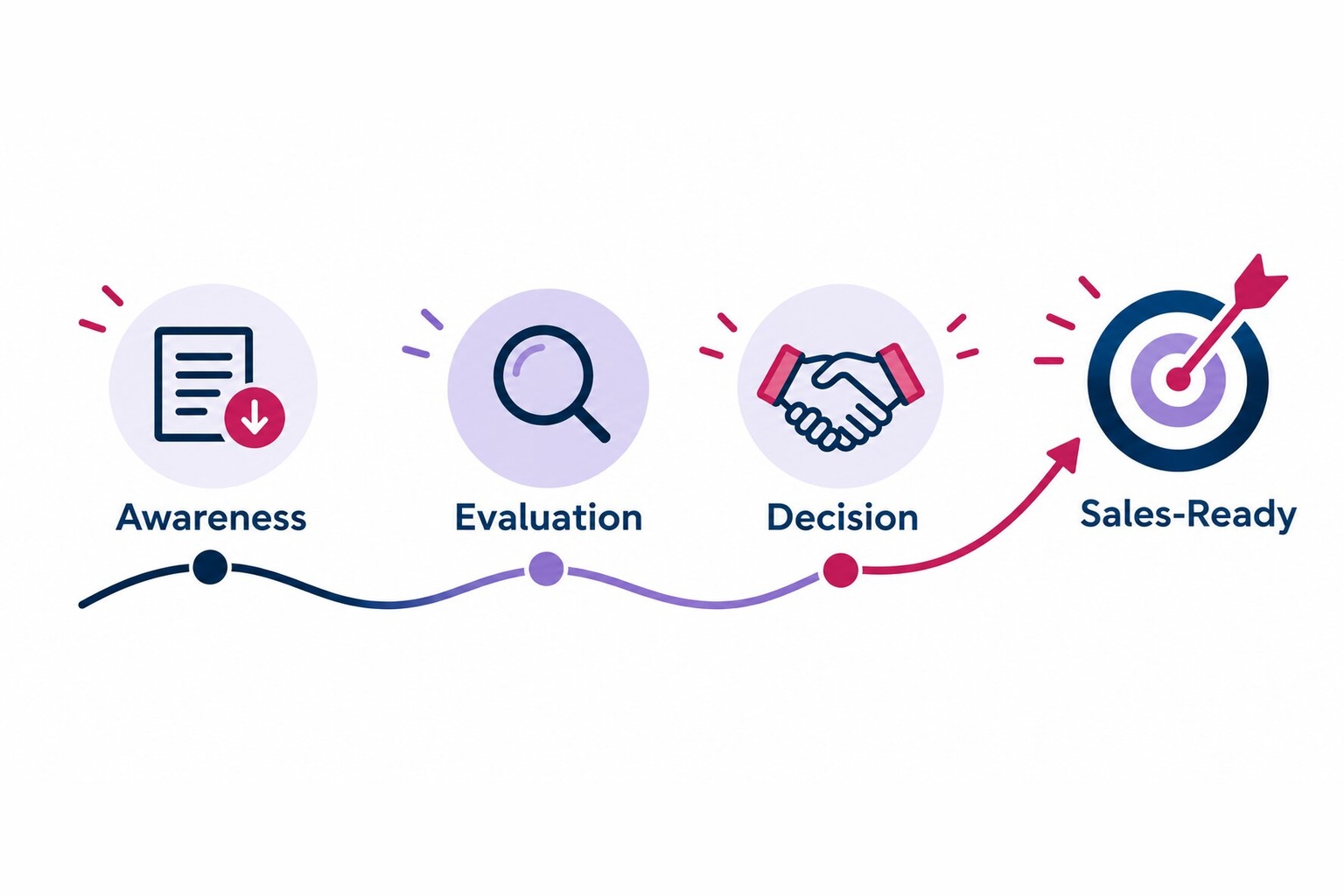
Awareness, evaluation, and decision stages provide a practical framework for planning content. Use them to identify information needs, while allowing prospects to move between stages as their priorities change.
At a company considering CRM replacement, the operations manager might already be comparing suppliers while the finance director is still questioning whether replacement is justified. Both need information, but they are not looking for the same answers.
1.Awareness: Help Prospects Understand the Problem
Early-stage content should help someone investigate the issue they are experiencing.
For a CRM project, that could include:
- A guide to identifying data quality problems.
- A checklist for diagnosing reporting gaps.
- An article comparing process improvements with platform replacement.
The next step should help the prospect continue that investigation. A diagnostic worksheet or educational webinar gives them somewhere useful to go without asking them to commit to a sales conversation.
A download shows interest in a topic. It does not confirm an approved project.
2.Evaluation: Help Prospects Compare Approaches
Evaluation content should make tradeoffs easier to assess.
A requirements template helps buyers define what they need. An integration guide explains technical considerations. A relevant case study shows how another organization handled implementation and which conditions influenced the outcome.
Include workload, responsibilities, limitations, and dependencies alongside the benefits. Buyers need enough detail to assess whether your approach suits their circumstances and explain their choice to colleagues.
3.Decision: Help Prospects Proceed with Confidence
Decision stage questions tend to become more specific. What will implementation involve? Who needs to participate? How will risk be managed?
Useful resources include pricing explanations, implementation plans, security documentation, customer references, and onboarding information.
A tailored demonstration or consultation may now be appropriate. Build it around what the prospect has already shared. Someone who has submitted requirements should not have to start again with a generic discovery conversation.
Core B2B Lead Nurturing Tactics
Effective lead nurturing connects the channels prospects encounter. Email, content, retargeting, and sales follow up should support the same next step without repeating the same message everywhere.
1.Build Segmented Email Sequences
Segment contacts according to differences that change what they need to hear. Useful distinctions include their role, business challenge, product interest, buying stage, or whether an active project exists.
Start with a manageable structure. A few meaningful segments are easier to maintain than dozens of lists with little difference between them.
For example, a technical stakeholder might receive integration resources, while a project owner receives planning templates and implementation guidance. CRM and marketing automation tools use contact properties and interaction histories to support segmentation and relevant follow up.
Define exit rules alongside entry rules. Someone who books a consultation should leave a sequence that asks them to book one. Suppress unsubscribed contacts and coordinate messages for active opportunities with the sales team.
2.Give Each Content Asset a Clear Job
Review your content by the question it answers.
A checklist helps identify gaps. A comparison guide supports evaluation. A case study provides evidence. An implementation plan explains what happens after approval.
For a CRM prospect, a sequence might deliver the requested checklist, offer a data cleanup worksheet, and then share a relevant implementation example. Each message should add something useful instead of finding another way to repeat your service benefits.
Let prospects skip ahead. A direct request for help takes priority over the remaining campaign schedule.
3.Use Retargeting to Support the Next Step
Retargeting provides another opportunity to share relevant information, where consent, platform rules, and audience eligibility allow.
Match the message to the topic someone explored. A visitor to an integration guide might benefit from an implementation webinar. An introductory brand advertisement is less closely connected to that immediate need.
Set frequency controls and appropriate exclusions. Existing customers, converted prospects, and people in active sales conversations may need different messages or no campaign exposure.
Treat an ad interaction as one piece of context. It should not, by itself, determine whether someone is sales ready.
4.Make Sales and Marketing Handoffs Explicit
A handoff should transfer context, not just contact details.
Agree on:
- The conditions that trigger routing.
- The person or team responsible for responding.
- A response target the team can meet.
- The information sales needs before making contact.
- What happens when a lead is returned to marketing.
Include the prospect’s stated challenge, known requirements, relevant activity, and direct questions. Shared CRM records help preserve that history across teams.
Sales should record why a lead cannot progress. Timing, unsuitable requirements, and missing stakeholder support call for different next steps. Marketing can then adjust the follow up instead of restarting the same sequence.
Lead Scoring and Knowing When a Lead Is Sales Ready
Lead scoring helps your team prioritize follow up. Qualification establishes whether there is a credible opportunity to pursue.
A useful model considers both fit and behavior. Salesforce distinguishes scoring based on what a prospect does from grading based on who the prospect is. Together, these provide a clearer view of engagement and suitability.
1.Assess Fit
Start by checking whether the company needs, and can use, what you offer.
Depending on your business, relevant criteria might include:
- Industry and company size.
- Location and service availability.
- Business requirements.
- Technical compatibility.
- The contact’s role in the buying process.
Separate missing information from confirmed poor fit. An unknown budget requires clarification. A budget that cannot support the work presents a different issue.
2.Assess Behavior
Behavioral signals include demonstration requests, submitted project details, webinar attendance, and repeated interest in implementation resources.
Weight actions according to their meaning. A direct request to discuss a project deserves a different response from a general guide download. Lead scoring tools combine contact and company attributes with actions such as page visits and form submissions.
Include recency in the model. Engagement from last year may have little bearing on current readiness. Prevent repeated low value actions from inflating a score indefinitely, too.
3.Agree on a Shared Sales Ready Definition
Sales and marketing should decide together which conditions justify a handoff.
A working definition might require suitable company fit, a relevant business need, and evidence that a conversation would help move the project forward. Criteria may vary across services or customer segments.
Give direct enquiries their own route. Someone asking for a proposal should not have to accumulate campaign points before receiving a response.
Review scoring against actual outcomes. Which leads become credible opportunities? Which are consistently returned, and why? Adjust the model using those findings rather than treating its original thresholds as permanent.
Common B2B Lead Nurturing Mistakes
Lead nurturing campaigns lose relevance when contact rules, ownership, or feedback processes are unclear. More content will not necessarily fix those problems.
-
Over Emailing Without Adding Value
Several downloads should not automatically enroll a prospect in several overlapping sequences.
Coordinate frequency across campaigns and give each message a purpose. Watch unsubscribes, negative replies, and declining engagement, then review whether the content and timing still make sense.
Where possible, let contacts express their preferences. Silence is not a reliable instruction to send more email.
-
Sending One Size Fits All Content
Personalization needs to go beyond inserting a first name.
An IT stakeholder may need integration documentation. A finance stakeholder may want help evaluating cost and risk. A generic benefits email gives neither much support for the decision in front of them.
Build content paths around distinctions your team can maintain reliably. A small set of useful journeys is preferable to an elaborate program filled with interchangeable messages.
-
Responding Slowly to Explicit Interest
A consultation request should not wait behind routine campaign activity.
Separate direct enquiries and substantive replies from lower intent interactions. Assign ownership and make sure the responsible person receives the prospect’s question and relevant history.
An automated acknowledgement confirms receipt. A useful response addresses what the person asked and explains what happens next.
-
Operating Without a Sales Feedback Loop
“Not ready” tells marketing very little. Was the project delayed, the budget unsuitable, or the contact unable to secure stakeholder support?
Ask sales to record a specific reason when returning a lead. A project postponed until the next financial year needs a different approach from a requirement your business cannot meet.
Review these patterns regularly. They may reveal missing resources, poor targeting, unclear qualification criteria, or problems with the handoff itself.
-
Measuring Activity Instead of Progress
Email opens and downloads help describe engagement, but they are not the end goal.
Track sales acceptance, qualified meetings, opportunity creation, and conversion between agreed stages. Review time to opportunity and comparable sales cycle lengths, allowing for changes in deal size and lead mix.
Evaluate B2B lead generation alongside nurturing. Increasing captured contacts has limited value if few fit your target customers or progress toward a useful conversation.
The useful question is whether more leads are becoming qualified opportunities, not whether the campaign report contains more activity.
Build a Nurturing Program That Helps Buyers Move Forward
A prospect should leave each interaction better equipped to decide. That may mean understanding a problem, comparing approaches, or getting the detail needed for internal approval.
Start with one audience and one journey. Identify the questions that delay progress, build a manageable content sequence, define the sales handoff, and review what happens after leads reach sales.
A well-designed program may shorten the sales cycle by reducing avoidable delays, including unanswered questions and poorly timed follow up. It cannot remove budget constraints or force an approval, but it can make the next step clearer.
Our demand generation services bring together marketing automation, email campaigns, lead nurturing, and lead scoring. If leads are entering your CRM but not progressing to sales conversations, start by looking at where they stall and what information they need next.


Tell us your thoughts in the comments