


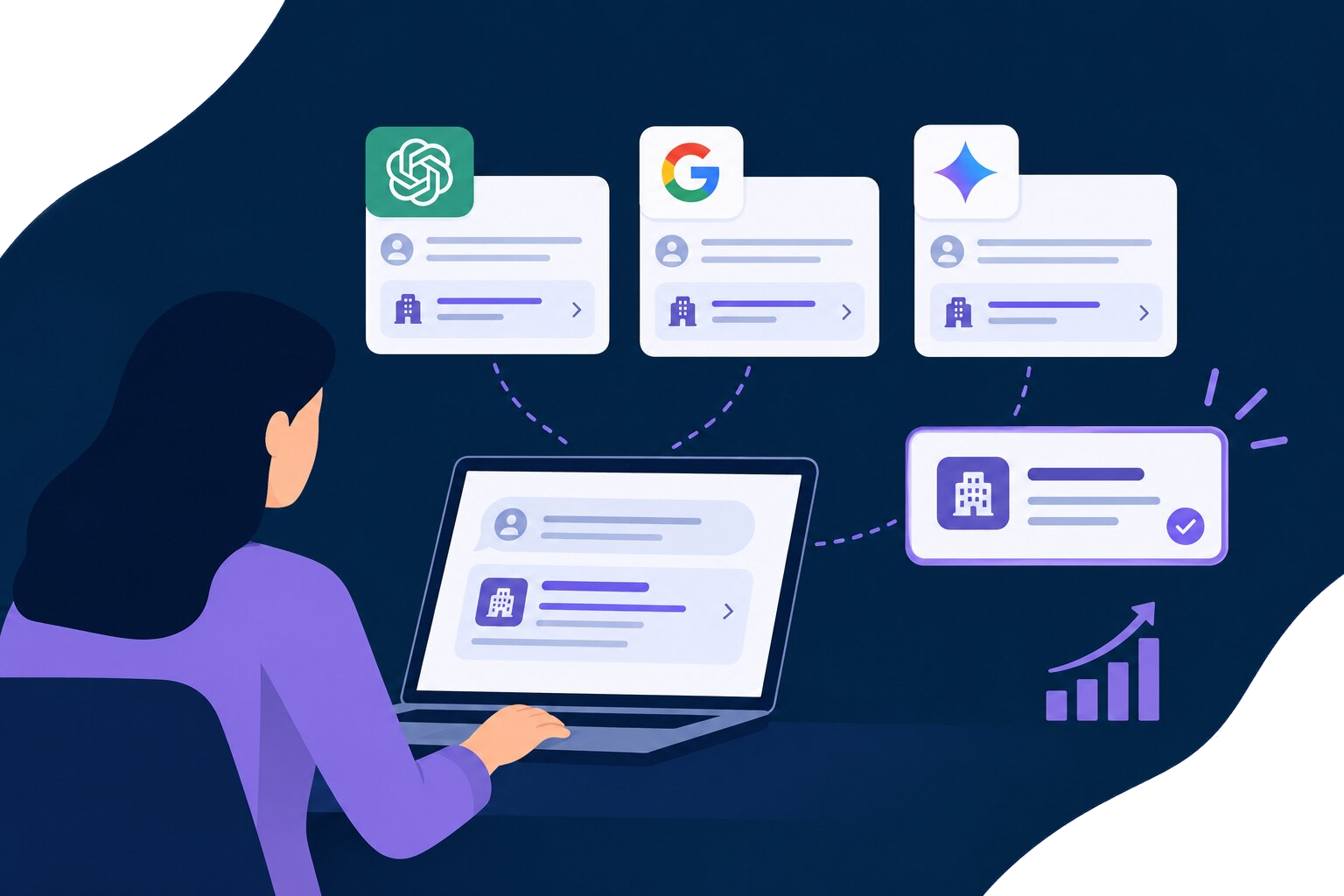
“Which CRM implementation partners should a mid-sized manufacturer consider?”
A buyer asks an AI assistant that question and receives a shortlist, provider descriptions, and supporting links. Before visiting a supplier’s website, they already have a starting point for their research.
Does your business appear? If it does, is the description accurate, and does the answer explain why your company belongs on the list?
AI search visibility shows whether your brand appears in AI generated answers, how it is described, and which sources support those descriptions. A passing mention is different from a recommendation, and neither guarantees that your website will be cited. Traditional ranking reports do not capture these differences.
An AI visibility audit gives your team a practical way to investigate. Test real buyer questions across ChatGPT, Gemini, and Google AI Mode, record the answers, and identify where clearer information or stronger evidence could help.
The aim is to understand what potential customers encounter when they ask AI systems for advice, not simply collect another visibility score.
Why Rankings Alone No Longer Show Visibility
A ranking report shows where a page appears for a tracked query. An AI answer can combine information from several sources; name selected providers and explain their suitability without presenting a conventional results list.
Google explains that AI Mode may use “query fan out”, running related searches across subtopics and data sources to develop an answer. Its supporting links may therefore extend beyond the pages you expect from a single keyword search.
Your brand might be:
- Recommended as a suitable provider.
- Mentioned without an explicit recommendation.
- Linked through a citation to your content.
- Absent while competitors appear.
These outcomes can overlap. An answer may recommend your company and cite your website or name your business while linking to a third-party source.
AI share of voice adds a competitive perspective. Our share of voice guide explains the broader concept. For this audit, use a narrower definition: your brand’s proportion of observed vendor appearances across a fixed question set.
Use the results as a consistent sample of the answers buyers may encounter.
Build Your Buyer Question List
Start with one service, customer segment, and market. Testing unrelated services together makes the findings harder to interpret.
Collect 20 to 30 questions from:
- Sales conversations: objections, comparison requests, and shortlist criteria.
- Search Console: queries bringing people to relevant pages.
- People Also Ask: related questions to validate against customer needs.
Record where each question came from. Search suggestions can reveal useful topics, but they do not establish customer demand by themselves.
The following 24 questions use CRM implementation as an example. Replace them with questions supported by your own research.
Awareness Questions
- What causes CRM implementation projects to fail?
- When should a manufacturer replace its CRM?
- Can CRM data problems be fixed without changing platforms?
- What should we assess before starting a CRM migration?
- What does a CRM implementation partner do?
- Which departments should help define CRM requirements?
- What affects the cost of CRM implementation?
- How should we prepare customer data before migration?
Evaluation Questions
- Which CRM implementation partners serve mid-sized manufacturers in [market]?
- Which providers integrate [CRM platform] with [ERP platform]?
- How should we compare CRM implementation proposals?
- Should we use an independent consultant or a platform partner?
- Which providers support both migration and employee training?
- What evidence should we request from an implementation partner?
- How do fixed price and time and materials proposals compare?
- Which partners support multi location manufacturers in [market]?
Decision Questions
- Which three partners should a mid-sized manufacturer in [market] shortlist for [CRM platform], ERP integration, and employee training?
- What questions should we ask shortlisted implementation partners?
- What should a CRM implementation statement of work include?
- How can we assess a provider’s data security practices?
- What references should we request before appointing a partner?
- What should happen during the first month of implementation?
- Which risks should our contract and project plan address?
- How should we evaluate post launch support?
Replace every bracketed placeholder before testing. Use the same market, platforms, and buyer requirements across all three products.
Keep baseline questions unbranded. Asking an assistant about your company by name tests prompted recognition rather than whether it appears naturally.
Run branded questions separately to investigate accuracy, comparisons, and outdated information.
Run the Audit
Use identical question wording across ChatGPT, Gemini, and Google AI Mode. The products differ, but a consistent starting point makes comparison more useful.
Standardize the Testing Conditions
Record the date, product, visible model or mode, language, target market, account tier, and relevant personalization settings. Note whether web search was selected or visibly used.
Start each baseline question in a fresh conversation, without earlier discussion or uploaded documents.
This reduces avoidable variation, although it cannot remove every contextual influence. OpenAI explains that ChatGPT Search may use approximate location and, when enabled, relevant memories when rewriting queries. A new conversation should not be assumed to remove every influence.
Test the consumer interfaces your buyers use. If you introduce API based monitoring later, report those results separately rather than assuming they reproduce the same experience.
Record Each Answer Consistently
Use one spreadsheet row per question, platform, and run.
| Field | What to record |
|---|---|
| Test details | Question ID, buying stage, platform, date, and run number. |
| Conditions | Market, language, account context, visible mode, and search status. |
| Brand named | Yes or no. |
| Explicit recommendation | Yes or no, with supporting wording. |
| Brand website cited | Yes or no, with the URL. |
| Third-party evidence | Sources supporting claims about your brand. |
| Placement | Stated rank or order of appearance. |
| Accuracy | Correct details, errors, omissions, and outdated claims. |
| Competitors | Providers named and their descriptions. |
| Evidence | Saved answer, screenshot, or conversation link. |
Keep observations separate from explanations. “Brand absent” is a finding. “Our website lacks authority” is a hypothesis that needs further investigation.
Repeat the Tests
Three runs per question provide a manageable starting point. With 24 questions across three platforms, that produces 216 answer records.
Look for patterns across the results rather than drawing conclusions from a single answer. Preserve answers that name no vendors, and record refusals, technical failures, and unavailable responses separately. State which records enter each calculation.
If you want to examine conversational follow ups, create a second test with standardized follow up questions. Keep it separate from the fresh conversation baseline.
Reading the Results
Review results by platform and buying stage before combining them. A single overall figure can hide strong shortlist visibility or a recurring accuracy problem.
Mention and Recommendation Rates
Mention rate is the percentage of valid answers containing your brand. If it appears in 18 of 72 valid answers on one platform, the mention rate is 25%.
Count the brand once per answer, even when it appears repeatedly. Calculate recommendation rate separately, counting answers that explicitly present your business as a suitable option.
Use all valid answers as one baseline, then report vendor selection questions separately. Awareness questions may legitimately produce no company names.
Citation Presence and Validity
First record whether an answer cites your website or a third-party source supporting a statement about your brand.
Then open the links and check:
- Does the page exist?
- Does it support the associated statement?
- Is the information current?
- Is the cited organization the correct business?
ChatGPT Search may display citations and a sources view. Gemini may provide sources or related links, although not every response includes them. Record what is visible rather than inferring how an uncited answer was generated.
Keep Gemini’s double check links separate. Google notes that links surfaced during verification are not necessarily sources used to generate the original response.
Position Within the Answer
For an explicitly ranked shortlist, record the stated rank. For an unranked list, record order of appearance without presenting it as a formal ranking.
Also note whether your brand appears in the opening shortlist or only in a passing reference. A higher position gives your brand more exposure, but it does not show whether a buyer would choose you.
Accuracy of the Description
Compare descriptions with verified company information:
- Services and specialisms.
- Industries and markets served.
- Locations and delivery coverage.
- Certifications and partnerships.
- Pricing statements and claimed results.
Prioritize material errors. Incorrect service coverage or an invented certification matters more than a minor wording difference.
For example, an AI assistant might describe your company as a CRM implementation partner for large enterprises, even though you primarily serve mid-sized manufacturers. That could put your business in front of the wrong buyers or cause suitable prospects to overlook you.
For each error, record the correct information and identify where it is currently published.
Competitor Patterns and AI Share of Voice
Look for repeated associations. One competitor may appear for industry expertise, another for platform certification, and another for international delivery.
Inspect the supporting sources to understand what evidence backs those descriptions. Record the patterns without assuming you know exactly how the platform selected each provider.
To calculate sample-based AI share of voice, count each vendor once per answer. Divide your brand’s appearances by all vendor appearances in the selected sample, then express the result as a percentage.
Define which entities qualify as vendors and apply the same rule throughout. This differs from mention rate because the denominator is vendor appearances, not answers.
Fixing the Gaps
Turn the findings into a list of fixes, starting with errors that could affect a buyer’s decision. Next, address missing decision stage information and weaknesses that recur across commercially important questions.
Fill Content Gaps
Map each priority question to the most relevant existing page. Where no suitable answer exists, decide whether to add a section, create a resource, or publish a new page.
A buyer comparing implementation partners may need delivery responsibilities, integration capabilities, and relevant project evidence. Another generic article about CRM benefits will not answer those questions.
Explain tradeoffs and limitations. Support claims with examples or evidence your business can substantiate.
Clarify Positioning and Entity Information
Check whether your homepage, service pages, company information, and credible external profiles describe the same business.
Make it straightforward to establish what you do, whom you serve, and where you operate. Correct outdated names, conflicting descriptions, and inaccurate partnership claims.
Structured data should reflect visible page content. Google says no special schema or new AI specific file is required for AI Overviews or AI Mode. Focus on accurate information and established search requirements rather than adding speculative technical files.
Develop Credible Third-Party Evidence
If answers repeatedly cite industry publications, partner directories, or independent resources, assess whether your business has a legitimate reason to appear there.
Relevant opportunities include verified partner listings, customer led case studies, expert contributions, and original research.
Prioritize editorial relevance and verifiable information. A generic paid mention is not equivalent to evidence demonstrating your capabilities.
Strengthen Existing Pages
Improve relevant pages before commissioning more content. Update outdated details, answer missing questions, strengthen internal links, and make important information accessible in text.
Review crawling and indexing issues as part of the work. For Google’s AI features, supporting pages must be indexed and eligible to appear in Search with a snippet. Google recommends established SEO fundamentals rather than special AI optimization requirements.
The priority is to make your pages accessible and your business information accurate, useful, and easy to verify.
Make AI Search Visibility a Monthly Routine
Repeat the core audit monthly alongside ranking, traffic, and conversion reports. Keep baseline questions stable and test new questions separately.
Track mention rate, recommendation rate, citations, accuracy, and competitor patterns. Record which pages and external profiles you update so you can compare them with the next audit.
If results improve after an update, investigate the relationship without assuming causation. Platform changes and shifting sources can also affect responses.
Search Console remains useful, but Google includes AI Overviews and AI Mode within overall Web performance repor
ting rather than providing a clean standalone traffic view. Combine that data with audit records and referral information.An AI search audit should help you answer three practical questions: Does your brand appear when buyers look for a provider? Is the information accurate? And what needs to change to make your business easier to assess?
Run the audit, fix the most important gaps, and test again next month. Over time, the results can help you decide where your content, technical SEO, and brand information need attention.
We can help you turn those findings into an actionable SEO strategy, from improving key service pages to strengthening the information buyers and AI systems use to understand your business.


Tell us your thoughts in the comments