


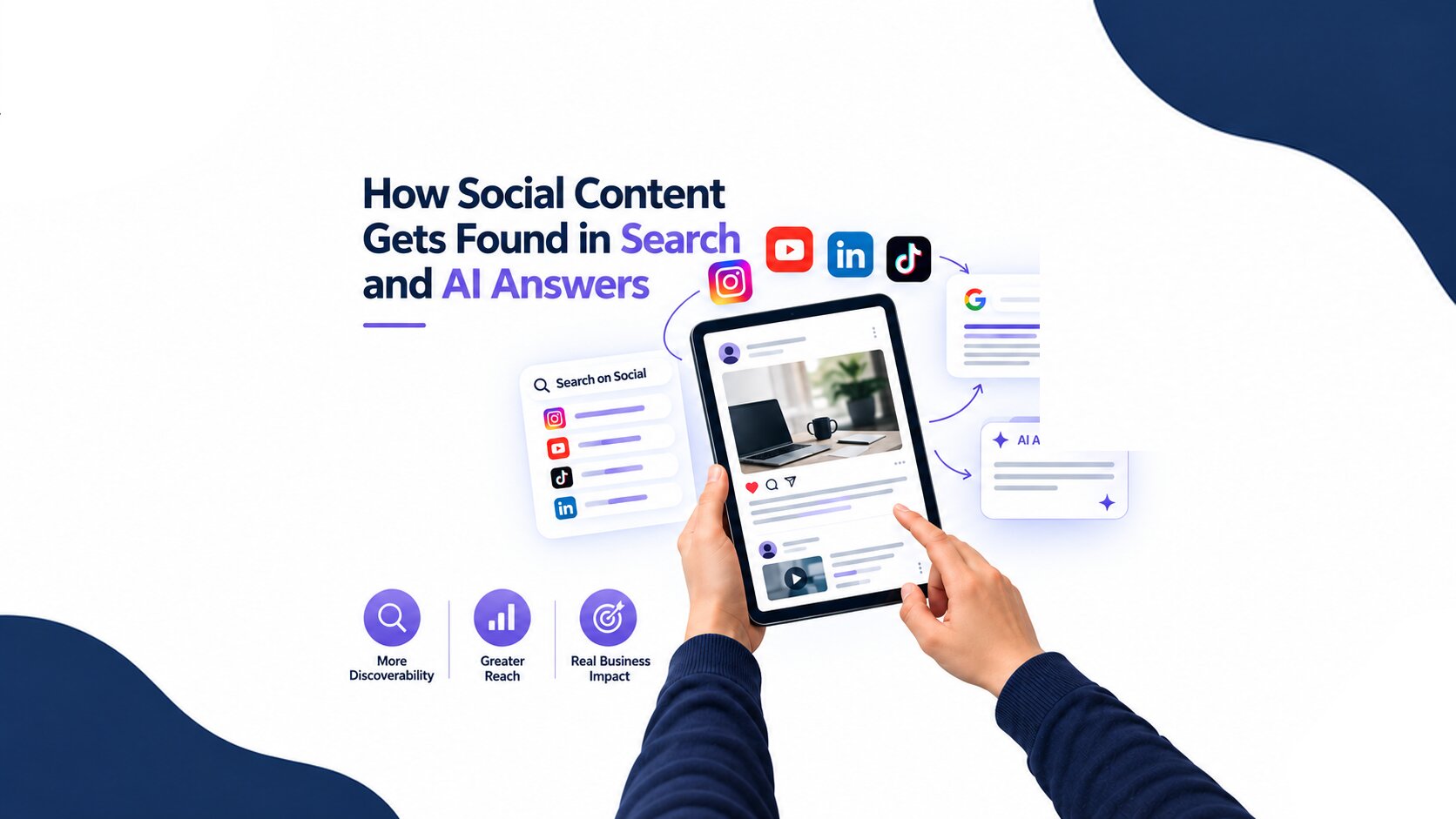
A potential customer does not have to start with Google to discover your business. They might search YouTube for a tutorial, look through LinkedIn posts for expert opinions, or find an Instagram video explaining a problem their team is trying to solve.
Social platforms are also places where people research services, compare options, and look for practical advice. Instagram provides search tools for finding relevant accounts and content, while TikTok considers how closely content matches a search query. For B2B brands, this creates opportunities to reach buyers while they are still exploring their options.
The challenge is making your expertise easy to find, not simply publishing more often.
Social media SEO means making social profiles and content easier to discover through relevant searches. In 2026, that means considering three channels: search within social platforms, Google search results, and AI-generated answers.
How Social Content Becomes Searchable
Search systems need context to connect content with a query. On social platforms, that context comes from profile information, captions, titles, hashtags, and video content. The available fields and their influence vary by platform.
Instagram identifies usernames, bios, captions, hashtags, and places among the information used to match content with searches. YouTube also considers titles, descriptions, tags, and video content when assessing relevance. These examples show why descriptive content matters, although each platform has its own ranking systems.
1. Captions and Post Text
Start with the question or problem your content addresses.
“Three CRM migration mistakes that delay your launch” establishes a subject and an outcome. “Your team needs to hear this” leaves both unclear.
Use relevant terminology naturally, then explain the answer. A caption should give readers enough context to understand the topic without relying on hashtags or keywords to do all the work.
2. On-Screen Text and Spoken Keywords
Make a video’s subject clear in its opening words and visuals. If you are explaining CRM data cleanup, introduce that topic early and use readable on-screen text to reinforce it.
YouTube explicitly considers video content when assessing relevance. That does not establish that every platform processes spoken words or text overlays in the same way. Consistent wording across the video and caption is still a useful way to make the subject clear.
3. Profile Information, Hashtags and Alt Text
Use a recognizable brand name and a straightforward description of your services. Choose hashtags that relate to the content rather than unrelated trending topics.
Where supported, write alt text that describes the image and its meaningful visual details. Its purpose is accessibility, not another place to repeat keywords.
Social activity also needs to be separated from Google ranking signals. Likes, shares, and follower counts are not direct Google ranking factors. Social content may still increase brand awareness, encourage branded searches, and introduce people to resources they later visit or reference. These are potential indirect benefits, not a direct ranking boost from engagement.
Where Social Content Appears in Search
A social post may be discovered within its original platform, appear in Google results, or become a potential source in an AI search experience. Each route offers different opportunities.
1. In App Search
People using social search often have a specific question, topic, company name, or service in mind.
TikTok provides a useful distinction between search and recommendations. In Search, how closely content matches the search term generally carries more weight than other categories of signals. In the For You feed, user interactions, including watch time, generally carry more weight.
This is why search optimization and feed performance need different considerations. A descriptive caption helps establish relevance, while a compelling opening gives viewers a reason to keep watching.
2. Google Search Results
Eligible public social content may also appear in Google results. Instagram permits search engines to index eligible public photos and videos from professional accounts belonging to adults, subject to its requirements and account settings.
Eligibility does not guarantee indexing or a prominent position. It does give brands another reason to publish content that remains useful beyond the original campaign.
For example, a CRM migration checklist discovered months after publication should still explain which steps it covers, who it is intended for, and what the reader should do next.
3. AI Generated Answers
AI search creates another potential discovery route, but publishing on social media does not guarantee that an AI system will mention or cite your content.
For Google’s AI Overviews and AI Mode, supporting pages must be indexed and eligible to appear in Search with a snippet. Google states that these features do not require additional technical requirements or special optimization methods. These guidelines apply to Google’s search features, not necessarily every AI product.
Give important expertise a detailed home on your website as well as a social presence. A social post might introduce a CRM migration risk, while a website article explains the process, supporting evidence, and exceptions.
When assessing AI visibility, record brand mentions separately from citations that link to a specific resource.
Social Media SEO Best Practices for LinkedIn, Instagram, TikTok and YouTube
Start with the information your team controls. These practical recommendations help make content clearer and more discoverable, but they should not be treated as a universal ranking formula.
| Content Field | What to Optimize | Where to Apply It |
|---|---|---|
| Profile name and bio | Identify your brand, services, and audience clearly. | LinkedIn company information, Instagram and TikTok bios, and YouTube channel details. |
| Captions and post text | Introduce a specific subject and provide useful context. | Social posts and supporting video copy. |
| On screen text and speech | Name the topic early, keep overlays readable, and check caption accuracy. | Reels, TikTok videos, Shorts, and longer videos. |
| Hashtags | Select relevant topic labels instead of unrelated popular terms. | Platforms and formats where hashtags are useful. |
| Alt text | Describe meaningful visual information. | Image formats that support custom alt text. |
| Video titles and descriptions | Explain the subject, scope, and expected outcome accurately. | Particularly important for YouTube. |
YouTube identifies titles, descriptions, tags, and video content among the information used to assess relevance.
- LinkedIn SEO: Make your expertise specific. Your company description should explain what you do and who you help, rather than relying on broad phrases such as “transforming business outcomes”. Apply the same approach to posts. “Before migrating your CRM, decide who owns duplicate record cleanup” gives a relevant buyer a concrete task to consider.
- Instagram SEO: Instagram SEO starts with context as well as visuals. A carousel titled “CRM Migration Checklist” should explain the steps it covers in the caption, such as data cleanup, field mapping, and testing. Descriptive profile information and captions also align with Instagram’s published search guidance.
- TikTok SEO: Connect the question in the caption with the video’s opening explanation. If the video promises to explain CRM field mapping, get to the example quickly. TikTok’s search guidance supports addressing a defined search need. Focus on answering the question clearly rather than following an assumed keyword placement formula.
- YouTube SEO: Use titles that explain the task. “How to Map CRM Fields Before a Data Migration” is more informative than “Our Ultimate Migration Framework”. Then deliver the promised explanation. YouTube considers engagement and quality alongside relevance, so a descriptive title needs useful content behind it.
Using Keyword Research to Plan Social Content
Keyword research helps turn publishing decisions into answers to identifiable customer needs. Start by choosing the question, then decide which format will answer it best.
1. Find Questions in Search Data and Customer Conversations
Combine website search query data with sales objections, support requests, and platform search suggestions.
For a CRM migration topic, useful starting questions include:
- What should we check before migrating CRM data?
- How do we remove duplicate customer records?
- What is CRM field mapping?
- How long should migration testing take?
Some questions need a definition. Others need a checklist or demonstration. Identifying the intent helps you choose the right format.
TikTok’s Creator Search Insights provides additional platform-specific information, including searched topics, related searches, content gaps, and search performance.
2. Build a Series Around Connected Tasks
Group related questions into a useful sequence. A CRM migration series could cover preparation, data cleanup, field mapping, testing, and staff adoption.
Each post should still work independently. Someone discovering a video about testing through search should not need to watch four earlier posts to understand it.
3.Adapt the Answer to Each Platform
One customer question can support several formats:
- LinkedIn: A decision framework explaining who should approve field mappings.
- Instagram: A carousel showing a pre-migration checklist.
- TikTok: A short demonstration of a common mapping error.
- YouTube: A walkthrough of the mapping and validation process.
- Website: A detailed guide covering responsibilities, examples, and exceptions.
Keep the underlying advice consistent but adjust the depth and presentation. A short video needs a focused answer, while a website resource has room for detailed instructions and exceptions.
4. Write Hooks That Name the Problem
Replace “This changes everything” with “Migrating your CRM? Check these three fields before importing contacts.”
The second opening tells a relevant viewer what they will learn. Specificity makes the content more useful without forcing exact match keywords into every sentence.
Measuring Social Media SEO Performance
Engagement alone cannot show whether content is improving search discovery. Review visibility, website activity, and business outcomes together.
- Branded Search Lift: Monitor searches containing your brand name and distinctive service or product names. Compare trends before and after campaigns, allowing for seasonality, paid advertising, PR, and other marketing activity. An increase may indicate stronger awareness, but it does not prove social media caused it. Use branded search as one indicator of progress rather than a standalone attribution measure.
- Referral Traffic: Add consistent UTM parameters to links your team controls so you can distinguish platforms, campaigns, and content themes. Review visits alongside meaningful actions, including consultation requests, resource downloads, and qualified enquiries. A post that generates fewer clicks but attracts relevant prospects may be more valuable than one that earns thousands of reactions without producing useful website visits. Keep direct social referrals separate from journeys that begin in Google. They represent different discovery paths.
- Assisted Conversions: Where your analytics setup and consent arrangements allow, examine whether social visits appear earlier in conversion paths. Compare that information with CRM records and responses to “How did you hear about us?” These sources provide additional context, although they will not capture every video view, colleague recommendation, or private content share.
- Platform Analytics and AI Visibility: Review search related metrics where available, alongside profile visits, watch time, saves, and enquiries. TikTok’s Creator Search Insights, for example, supports reviewing content performance in search. For AI discovery, record brand mentions, supporting citations, and referral visits separately. Google includes traffic from AI Overviews and AI Mode in overall Web performance reporting in Search Console, so that report does not provide a separate view of all AI search activity.
Use these indicators to understand which topics attract attention, bring relevant visitors to your website, and contribute to enquiries.
Bringing Social Media SEO and Organic Search Together
Your social posts and website content should answer the same customer questions at different levels of detail. A short video might explain one common mistake, a LinkedIn post could add expert perspective, and a website guide could walk someone through the full process.
For B2B brands, the goal is to make expertise easier to find and give potential customers useful next steps, wherever their research begins. Our social media marketing services and SEO services help businesses connect content planning, keyword research, optimization, and reporting. Start with the questions your buyers ask most often. Build content that answers them clearly, then measure which topics bring the right people closer to your business.



Tell us your thoughts in the comments