


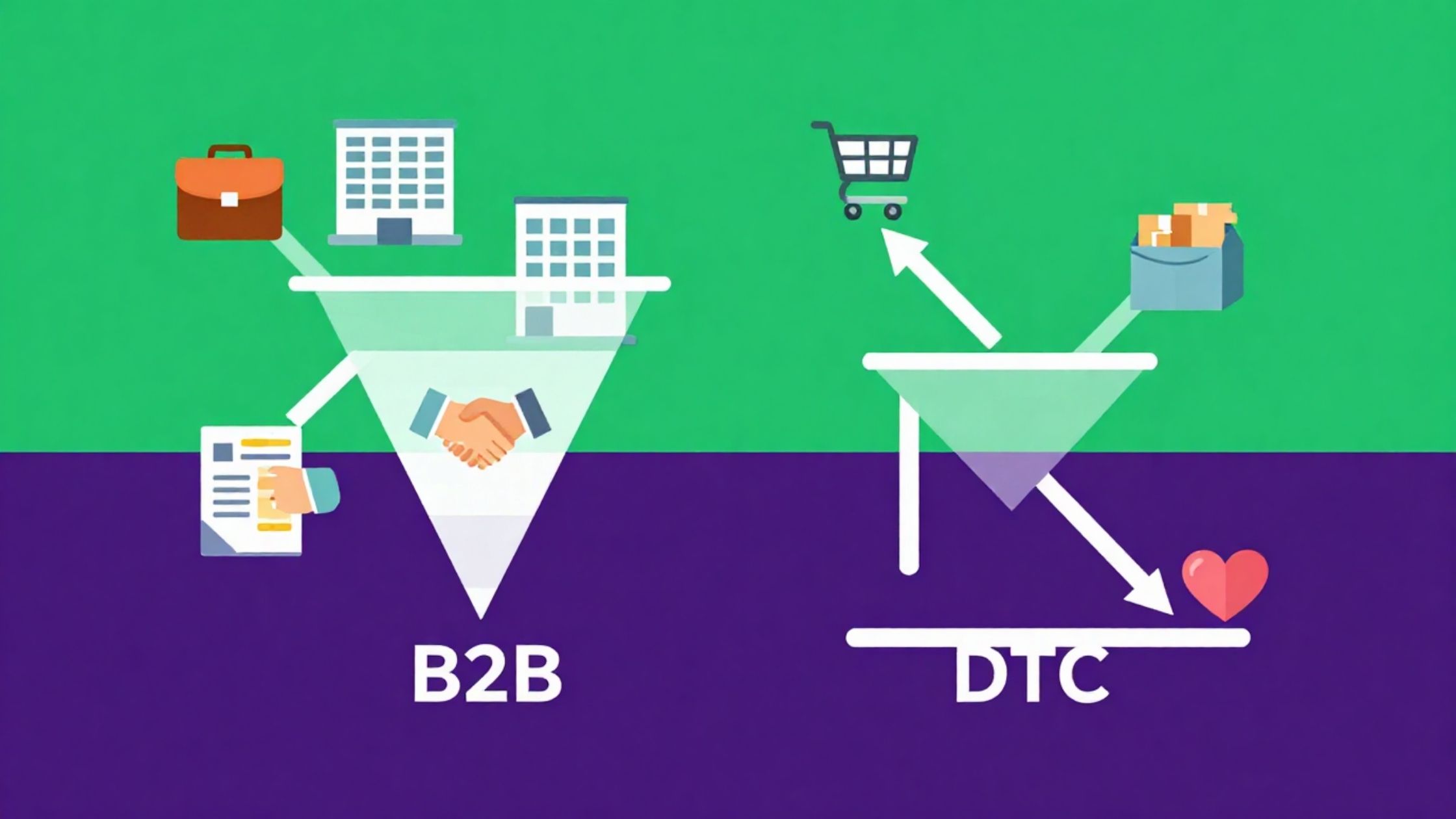
The digital funnel is not one-size-fits-all. At Aumcore, we work with both B2B enterprise clients and direct-to-consumer brands, and the strategic differences between these models are profound. A funnel optimized for B2B lead generation will fail spectacularly if applied to DTC ecommerce, and vice versa.
The distinction goes far beyond audience size or transaction value. B2B and DTC funnels differ fundamentally in sales cycle length, decision-making dynamics, content requirements, conversion optimization, and media effectiveness. Understanding these differences is essential for building digital strategies that actually convert.
This article breaks down exactly what changes between B2B and DTC models across funnel design, content strategy, UX optimization, and media mix, drawing on our experience helping clients succeed in both spaces.
The Fundamental Differences That Shape Everything
Before diving into tactics, it is critical to understand why B2B and DTC funnels operate so differently.
Decision-Making Dynamics
B2B purchases involve buying committees with 6 to 10 stakeholders, each with different priorities, concerns, and veto power. A marketing manager may initiate the search, IT must approve technical requirements, finance evaluates ROI, legal reviews contracts, and executives make final decisions. Every stakeholder needs different information at different stages.
DTC purchases are made by individuals or households, typically one decision-maker acting independently. The person who discovers the product is usually the person who buys it, dramatically simplifying the funnel.
Sales Cycle Length
B2B sales cycles range from 3 to 18 months for complex enterprise solutions. Prospects research extensively, request demos, conduct vendor comparisons, negotiate terms, and require internal approvals before committing. The funnel must nurture relationships over extended periods.
DTC sales cycles range from minutes to days. Consumers discover a product, evaluate quickly through reviews and visual content, and purchase immediately if convinced. The funnel must capture attention and drive action rapidly.
Purchase Motivation
B2B buyers are driven by logic, ROI justification, and risk mitigation. Every purchase requires demonstrating business value, efficiency gains, or revenue impact. Emotional factors exist but are secondary to rational evaluation.
DTC buyers are driven by emotion, desire, and convenience. While practical considerations matter, purchase decisions often stem from lifestyle aspirations, instant gratification, or impulse. Emotional triggers are primary.
Relationship Type
B2B funnels prioritize long-term partnerships over one-time transactions. Switching costs are high, implementation requires ongoing support, and customer lifetime value accumulates over years of contract renewals and upsells. The funnel must build trust and position the brand as a strategic partner.
DTC funnels may pursue repeat purchases but each transaction stands alone. While building loyalty matters, many customers make single purchases or engage episodically. The funnel must maximize immediate conversion while creating pathways for repeat business.
These fundamental differences cascade through every aspect of funnel design, content strategy, UX optimization, and media selection.
Funnel Architecture: B2B vs DTC
B2B Funnel Structure
B2B funnels typically follow a longer, more complex structure designed to educate, build trust, and nurture relationships through extended sales cycles.
Awareness Stage
The awareness stage focuses on problem identification and education.
- Prospects may not fully understand their problem or recognize better solutions exist.
- Content educates on industry challenges, emerging trends, and solution categories.
- The goal is positioning the brand as a thought leader and trusted resource.
- Metrics focus on reach, engagement, and brand awareness rather than immediate conversion.
Consideration Stage
The consideration stage provides solution evaluation frameworks.
- Prospects actively research solution approaches and evaluate vendor options.
- Content includes comparison guides, vendor selection checklists, and category education.
- The goal is getting shortlisted while demonstrating expertise and differentiation.
- Metrics track content downloads, webinar attendance, and demo requests.
Decision Stage
The decision stage validates specific vendor selection.
- Prospects compare specific products, evaluate implementation requirements, and justify ROI.
- Content provides case studies, ROI calculators, technical documentation, and proof-of-concept materials.
- The goal is removing objections and enabling internal selling to stakeholders.
- Metrics focus on sales-qualified leads, pipeline value, and sales cycle velocity.
Post-Purchase Stage
The post-purchase stage emphasizes retention and expansion.
- Onboarding ensures successful implementation and adoption.
- Ongoing engagement builds loyalty and identifies upsell opportunities.
- Advocacy programs turn satisfied customers into referral sources and case study participants.
- Metrics track retention rates, net revenue retention, and customer lifetime value.
DTC Funnel Structure
DTC funnels are compressed, designed to move consumers from discovery to purchase rapidly while minimizing friction.
Discovery Stage
The discovery stage captures attention quickly.
- Consumers encounter the brand through social media, search, display ads, or influencer content.
- First impressions must be immediate and compelling, often visual or emotional.
- The goal is sparking interest strong enough to click through.
- Metrics focus on reach, impressions, and click-through rates.
Evaluation Stage
The evaluation stage provides rapid validation.
- Consumers quickly assess whether the product meets their needs through imagery, reviews, and concise benefits.
- Decision-making happens in minutes, often on mobile devices.
- The goal is building sufficient confidence to add to cart.
- Metrics track product page engagement, add-to-cart rates, and time on site.
Purchase Stage
The purchase stage minimizes friction.
- Checkout must be fast, simple, and trustworthy to prevent abandonment.
- Multiple payment options, guest checkout, and mobile optimization are critical.
- The goal is completing the transaction before interest fades.
- Metrics focus on conversion rate, cart abandonment, and average order value.
Retention Stage
The retention stage drives repeat purchases.
- Email marketing, retargeting, and loyalty programs encourage additional purchases.
- Subscription models create recurring revenue when applicable.
- The goal is increasing lifetime value through repeat transactions.
- Metrics track repeat purchase rate, customer lifetime value, and retention cohorts.
The B2B funnel is measured in months with multiple touchpoints before conversion. The DTC funnel is measured in sessions with the goal of converting on the first or second visit.
Content Strategy: What Each Model Requires
Content needs differ dramatically between B2B and DTC funnels based on how decisions are made and what information buyers need.
B2B Content Characteristics
B2B content is educational, detailed, and ROI-focused, designed to inform multiple stakeholders and support rational evaluation.
Content Types That Perform Well
- Long-form guides and whitepapers that demonstrate deep expertise on complex topics.
- Case studies with quantified results that prove business impact and ROI.
- Webinars and virtual events that allow prospect interaction and detailed explanation.
- Product comparison content that helps buyers evaluate options systematically.
- Technical documentation that addresses implementation and integration concerns.
- ROI calculators and assessment tools that help justify purchase decisions.
Content Tone And Style
- Professional and authoritative, establishing credibility and expertise.
- Data-driven with statistics, research citations, and measurable outcomes.
- Problem-solution framing that connects business challenges to specific solutions.
- Assumes a sophisticated audience familiar with industry terminology.
Content Distribution
- LinkedIn for professional audiences and decision-maker reach.
- Email nurture sequences that provide progressive value over extended sales cycles.
- Industry publications and trade media for thought leadership positioning.
- Search-optimized content targeting solution-focused and comparison queries.
DTC Content Characteristics
DTC content is engaging, visual, and benefit-focused, designed to create desire and enable quick decisions.
Content Types That Perform Well
- High-quality product photography and lifestyle imagery that shows products in use.
- Short-form video content demonstrating products, sharing customer stories, or entertaining.
- User-generated content and customer reviews that provide social proof.
- Influencer collaborations that lend credibility and reach target audiences.
- How-to content and styling guides that inspire purchase and reduce uncertainty.
- Social media content that builds brand affinity and community.
Content Tone And Style
- Conversational and relatable, connecting with consumers emotionally.
- Benefit-focused, highlighting outcomes, experiences, and lifestyle improvements.
- Visually compelling with emphasis on aesthetics and brand personality.
- Simplified language accessible to broad audiences.
Content Distribution
- Instagram and TikTok for visual storytelling and younger demographics.
- Pinterest for inspiration and product discovery, particularly in lifestyle categories.
- YouTube for longer-form product reviews, tutorials, and brand storytelling.
- Paid social for targeted reach and retargeting warm audiences.
The investment in B2B content development is higher per piece, but volume is lower. DTC requires higher content volume across more formats, but individual pieces can be shorter and more focused on immediacy than depth.
UX And Conversion Optimization: Different Goals, Different Approaches
User experience requirements diverge significantly based on funnel complexity and purchase behavior.
B2B UX Priorities
B2B websites must support extended research, multi-stakeholder evaluation, and complex decision-making.
Navigation And Information Architecture
- Clear segmentation by industry, company size, or use case to help prospects find relevant information quickly.
- Resource libraries organized by buyer journey stage and content type.
- Extensive search functionality as visitors often seek specific information.
- Clear pathways to solution pages, case studies, pricing, and demo requests.
Conversion Paths
- Multiple conversion opportunities at different commitment levels, including newsletter signup, content download, webinar registration, and demo requests.
- Forms that balance information gathering with conversion optimization, often requesting company details for qualification.
- Gated content for lead capture on high-value resources like reports or toolkits.
- Sales enablement features like ROI calculators, product configurators, or assessment tools.
Trust And Credibility Signals
- Customer logos and case studies prominently displayed.
- Security certifications, compliance badges, and industry recognitions.
- Detailed About and team pages establishing company credibility.
- Integration and partnership information for ecosystem compatibility.
Content Presentation
- Detailed product pages with comprehensive feature descriptions, specifications, and use cases.
- Comparison tables allowing feature-by-feature vendor evaluation.
- Technical documentation and implementation guides accessible to technical evaluators.
- Video demos and explainer content for complex products.
DTC UX Priorities
DTC websites must enable rapid evaluation and frictionless purchase, optimized for mobile and impulse behavior.
Navigation And Information Architecture
- Simple, intuitive navigation that gets visitors to products quickly.
- Visual category browsing with lifestyle imagery rather than text-heavy menus.
- Prominent search with autocomplete for direct product finding.
- Minimal clicks from homepage to product to checkout.
Conversion Paths
- Streamlined add-to-cart and checkout flows that minimize steps and form fields.
- Guest checkout options reducing barriers for first-time purchasers.
- Express checkout integration with Apple Pay, Google Pay, or Shop Pay.
- Exit-intent popups capturing abandoning visitors with offers or incentives.
Trust And Credibility Signals
- Customer reviews and ratings prominently displayed on product pages.
- User-generated content showing real customers using products.
- Return policies, shipping guarantees, and security badges at checkout.
- Social proof indicators like bestseller badges or purchased-by messaging.
Content Presentation
- Hero imagery and lifestyle photography that create emotional connection.
- Concise, benefit-focused product descriptions scannable on mobile.
- Size guides, color selectors, and product variants easily accessible.
- Sticky add-to-cart buttons that remain visible while scrolling.
B2B UX optimizes for information gathering and multi-visit engagement. DTC UX optimizes for speed, simplicity, and single-session conversion.
Media Mix And Channel Strategy
Channel effectiveness and investment allocation differ substantially between B2B and DTC models.
B2B Media Mix
B2B strategies emphasize channels that reach professional audiences and support extended nurture cycles.
Organic Search (SEO)
- Critical for capturing high-intent solution searches and comparison queries.
- Long sales cycles mean SEO provides compounding value as rankings improve.
- Content supports both demand generation and sales enablement.
- Investment horizons are typically 6 to 12 months but provide strong long-term ROI.
LinkedIn Advertising
- Dominant platform for B2B with sophisticated targeting by job title, company size, and industry.
- Effective for thought leadership content promotion and lead generation.
- Higher cost per click but better quality targeting than other social platforms.
- Particularly valuable for reaching executive and C-level decision-makers.
Content Syndication And Native Advertising
- Industry publications and B2B content networks extend reach to engaged audiences.
- Supports thought leadership positioning and demand generation.
- Lead generation through gated content downloads and webinar registrations.
Email Marketing
- Essential for nurturing leads through extended sales cycles.
- Segmentation by industry, company size, or buyer journey stage.
- Automated sequences that provide progressive value and maintain engagement.
- High ROI for both acquisition and retention.
Webinars And Virtual Events
- Effective for demonstrating expertise and generating qualified leads.
- Allows interactive engagement and multi-stakeholder attendance.
- Content can be repurposed across multiple formats.
Account-Based Marketing (ABM)
- Targeted campaigns for high-value accounts with personalized messaging.
- Coordinates marketing and sales efforts around specific prospects.
- Higher costs but significantly higher deal values justify investment.
Performance Vs Demand Generation Balance
B2B strategies must balance immediate lead generation with brand building that influences the dark funnel, where prospects research without visible engagement. Most successful approaches combine brand awareness investments with performance channels that capture in-market demand.
DTC Media Mix
DTC strategies prioritize channels that drive immediate traffic and conversion while building brand affinity.
Paid Social Advertising
- Meta platforms for broad reach and sophisticated targeting.
- TikTok for younger demographics and viral potential.
- Pinterest for product discovery in lifestyle and home categories.
- Strong emphasis on visual creative and direct-response objectives.
- Retargeting is critical for converting warm traffic.
Google Shopping And Paid Search
- Google Shopping for high-intent product searches.
- Branded search campaigns to capture existing brand awareness.
- Non-branded search for category terms and comparison queries.
- Typically lower cost per acquisition than social for bottom-funnel traffic.
Influencer Marketing
- Authentic endorsements that drive awareness and social proof.
- Micro-influencers often deliver better ROI than celebrity partnerships.
- Affiliate structures align influencer incentives with brand goals.
- Particularly effective for new brand launches and product drops.
Email And SMS Marketing
- Post-purchase sequences driving repeat purchases and reviews.
- Abandoned cart recovery with automated reminders and incentives.
- Promotional campaigns for sales, new products, and seasonal events.
- SMS for time-sensitive offers and shipping notifications.
Organic Social And Community
- Instagram and TikTok for brand storytelling and community engagement.
- User-generated content campaigns that turn customers into advocates.
- Community building through Facebook Groups or branded platforms.
- Lower immediate ROI but builds brand equity and reduces acquisition costs over time.
Display And Programmatic Advertising
- Retargeting site visitors across the web.
- Prospecting campaigns for awareness and consideration.
- Dynamic product ads showing browsed items.
Performance Focus
DTC media strategies are heavily performance-driven with emphasis on measurable ROAS, CAC, and LTV. Testing and optimization cycles are rapid, often weekly or daily, with quick channel shifts based on performance data.
Key Performance Indicators: What Success Looks Like
The metrics that matter differ significantly between B2B and DTC models.
B2B KPIs
Funnel Metrics
- Marketing-qualified leads (MQLs) and sales-qualified leads (SQLs) measuring lead volume and quality.
- Lead-to-opportunity conversion rates showing marketing effectiveness.
- Sales cycle velocity tracking how quickly deals progress.
- Pipeline value and pipeline coverage measuring future revenue potential.
Efficiency Metrics
- Cost per lead and cost per opportunity evaluating channel effectiveness.
- Marketing-sourced revenue and marketing-influenced revenue showing contribution.
- Return on marketing investment by channel and campaign.
- Sales and marketing alignment metrics like lead acceptance rate and follow-up speed.
Long-Term Value Metrics
- Customer acquisition cost relative to customer lifetime value.
- Customer retention and net revenue retention rates.
- Expansion revenue from upsells and cross-sells.
- Customer advocacy metrics like referrals and case study participation.
DTC KPIs
Conversion Funnel Metrics
- Website conversion rate from visit to purchase.
- Add-to-cart rate and cart abandonment rate identifying friction points.
- Average order value measuring transaction size.
- Time to conversion showing funnel efficiency.
Channel Performance Metrics
- Return on ad spend by channel, campaign, and creative.
- Customer acquisition cost trending over time.
- Channel attribution showing conversion path influence.
- Creative performance metrics like click-through rate and cost per click.
Customer Value Metrics
- Repeat purchase rate and purchase frequency.
- Customer lifetime value by acquisition channel and cohort.
- LTV to CAC ratio evaluating long-term profitability.
- Net Promoter Score indicating satisfaction and referral likelihood.
B2B success is measured in pipeline and long-term relationships. DTC success is measured in conversion rates and repeat purchase behavior.
Real-World Application: B2B SaaS Funnel
One of our B2B SaaS clients in the HR technology space needed to build pipeline for an enterprise product with an average contract value of $150,000 and 6 to 9 month sales cycles.
Awareness And Demand Generation
- Thought leadership content targeting HR executives on LinkedIn.
- SEO-optimized guides and reports on workforce challenges.
- Webinar series featuring industry experts and customer speakers.
- Goal was generating MQLs and building brand awareness in target accounts.
Consideration And Nurture
- Email sequences providing progressive value over 3 to 6 months.
- Comparison guides and vendor selection frameworks positioning the client favorably.
- Interactive ROI calculators qualifying prospects and demonstrating value.
- Retargeting campaigns keeping the brand visible during extended evaluation.
Decision And Conversion
- Detailed case studies with quantified results from similar companies.
- Product demos customized by industry and company size.
- Free trials or proof-of-concept programs for qualified enterprises.
- Sales enablement content supporting internal champion selling.
After 12 months of execution:
- Marketing-qualified leads increased by 156%.
- Lead-to-opportunity conversion rate improved by 43%.
- Average sales cycle decreased by 38 days.
- Marketing-sourced pipeline grew by 217%.
- Customer acquisition cost decreased by 29%.
The success came from aligning content, UX, and media to the complex, multi-stakeholder B2B buying process rather than trying to force immediate conversions.
Real-World Application: DTC Fashion Brand
One of our DTC fashion clients needed to scale revenue from $2M to $10M annually through digital channels while competing in a crowded market with established brands.
Discovery And Awareness
- Instagram and TikTok content showcasing products through lifestyle imagery and user-generated content.
- Influencer partnerships with micro-influencers in target demographics.
- Pinterest advertising driving product discovery for fashion-forward consumers.
- Goal was building brand awareness and driving traffic.
Evaluation And Conversion
- Product pages optimized for mobile with high-quality imagery and customer reviews.
- Size guides and styling recommendations reducing purchase uncertainty.
- Streamlined checkout with express payment options.
- Exit-intent popups offering first-purchase discounts to capture abandoning visitors.
Retention And Repeat Purchase
- Post-purchase email sequences requesting reviews and sharing styling tips.
- SMS campaigns for flash sales and new product launches.
- Loyalty programs rewarding repeat purchases and referrals.
- Retargeting campaigns bringing back browsers and previous purchasers.
After 10 months of execution:
- Website traffic increased by 284%.
- Conversion rate improved by 52%.
- Average order value grew by 31%.
- Repeat purchase rate increased by 67%.
- Customer acquisition cost decreased by 38%.
- Revenue grew from $2.1M to $8.7M annually.
The success came from optimizing for speed, removing friction, and creating emotional connection rather than lengthy education.
When Models Blend: Hybrid Approaches
Some businesses operate both B2B and DTC channels or serve audiences that span both models. In these cases, funnel strategies must be segmented.
We help clients implement:
- Separate subdirectories or microsites for B2B and DTC experiences with distinct navigation, messaging, and conversion paths.
- Audience segmentation that routes visitors to appropriate experiences based on intent signals.
- Content libraries that serve both audiences with clear filtering by business or consumer focus.
- Channel strategies that allocate budget appropriately to each model’s requirements.
- Measurement frameworks that track each funnel independently while understanding cross-influence.
The key is recognizing that one funnel cannot effectively serve both models and intentionally designing separate experiences.
Why Clients Choose Aumcore For Both B2B And DTC
Many agencies specialize exclusively in B2B or DTC. We excel at both because we understand the fundamental differences in how these funnels operate and what each model requires for success.
Our Expertise Includes
- Strategic frameworks that align funnel design to business model, sales cycle, and decision-making dynamics.
- Content capabilities spanning both long-form B2B thought leadership and high-volume DTC creative production.
- UX design experience optimized for both complex B2B research journeys and frictionless DTC conversion.
- Media expertise across B2B channels like LinkedIn and content syndication, as well as DTC channels like Meta, TikTok, and influencer marketing.
- Analytics sophistication tracking pipeline metrics for B2B and ROAS for DTC with appropriate attribution models.
For brands operating in either space or both, this versatility means working with a partner who understands what actually drives results in your specific model.
So, Is there A Difference?
B2B and DTC funnels are not variations on the same theme. They are fundamentally different systems requiring distinct strategies, content approaches, UX optimization, and media investment.
At Aumcore, we build funnels aligned to how buyers actually make decisions in each model. For B2B, that means supporting extended sales cycles with educational content, multi-stakeholder engagement, and ROI-focused messaging. For DTC, that means creating rapid conversion paths with emotional connection, minimal friction, and retention-focused experiences.
Understanding these differences and executing accordingly is what separates effective digital strategies from generic approaches that underperform in both spaces.



Tell us your thoughts in the comments